Showing posts with label bulgaria. Show all posts

Wednesday, February 8, 2023

2022 Totals

 It is once again time to share my personal ringing results for the previous year. As always, I'm quite late with this post, but I still think it's a good idea to share those stats, highlights, and personal observations with you all.


I will make a separate post about my nest monitoring results and observations of 2022, but my personal favorite was the clutch of Corn buntings(Emberiza calandra) that survived an intense hailstorm and still successfully fledged. I also managed to make a short film of a Red-backed shrike(Lanius collurio) pair feeding their young with different types of food. If you want to see this video please check it out on my Youtube channel.


For me, the highlights for 2023 were mainly the 8 Otus scops that I managed to ring, my first Caprimulgus europaeus, my first Turdus pilaris, the Ficedula species(which were also a first for me), the 11 Phylloscopus sibilatrix and the 43 Anthus trivialis.

In general, I had average ringing from the nesting season and fewer ringing days which resulted in fewer ringed birds compared to the previous year(for 2021 - total ringed: 691), but at the same time, I managed to ring 5 more species in 2022 compared to 2021(when I ringed birds out of 33 species).


Species

Sylvia atricapilla - 197

Parus major - 82

Anthus trivialis - 43

Cyanistes caeruleus - 38

Turdus merula - 22

Lanius collurio - 21

Phylloscopus trochilus - 20

Sylvia curruca - 19

Sylvia borin - 17

Sylvia communis - 13

Phylloscopus sibilatrix - 11

Parus lugubris - 10

Turdus philomelos - 10

Erithacus rubecula - 10

Muscicapa striata - 9

Otus scops - 8

Emberiza calandra - 5

Merops apiaster - 4

Emberiza citrinella - 4

Phylloscopus collybita - 4

Luscinia megarhynchos - 3

Sitta europaea - 3

Turdus pilaris - 2

Regulus ignicapilla - 2

Coccothraustes coccothraustes - 2

Aegithalos caudatus - 2

Phoenicurus phoenicurus - 2

Ficedula albicollis - 2

Streptopelia turtur - 2

Hippolais icterina - 1

Sylvia nisoria - 1

Dendrocopos major- 1

Ficedula hypoleuca - 1

Dendrocopos medius - 1

Regulus regulus - 1

Acrocephalus scirpaceus - 1

Garullus glandarius - 1

Caprimulgus europaeus - 1


Total : 577

Species: 38


Here are some of the photo highlights from 2022:


Turdus pilaris

Sylvia nisoria

Ficedula hypoleuca

Otus scops

Caprimulgus europaeus

Emberiza calandra nest

Streptopelia turtur hatchling

One of the 20+ Lanius collurio nests that I found

Merops apiaster

Phylloscopus sibilatrix


Monday, November 21, 2016

Bird ringing compilation 2015 - Bulgaria

Hi everyone !!!
It's been a long,long time since my last post here. I'm sorry for the long absence, but I finally decided to continue my blogging and in the next few days I will post a lot of pictures from the past year and a half.

In this post I will gather all of the good pictures from 2015.
I hope that you will like them :)

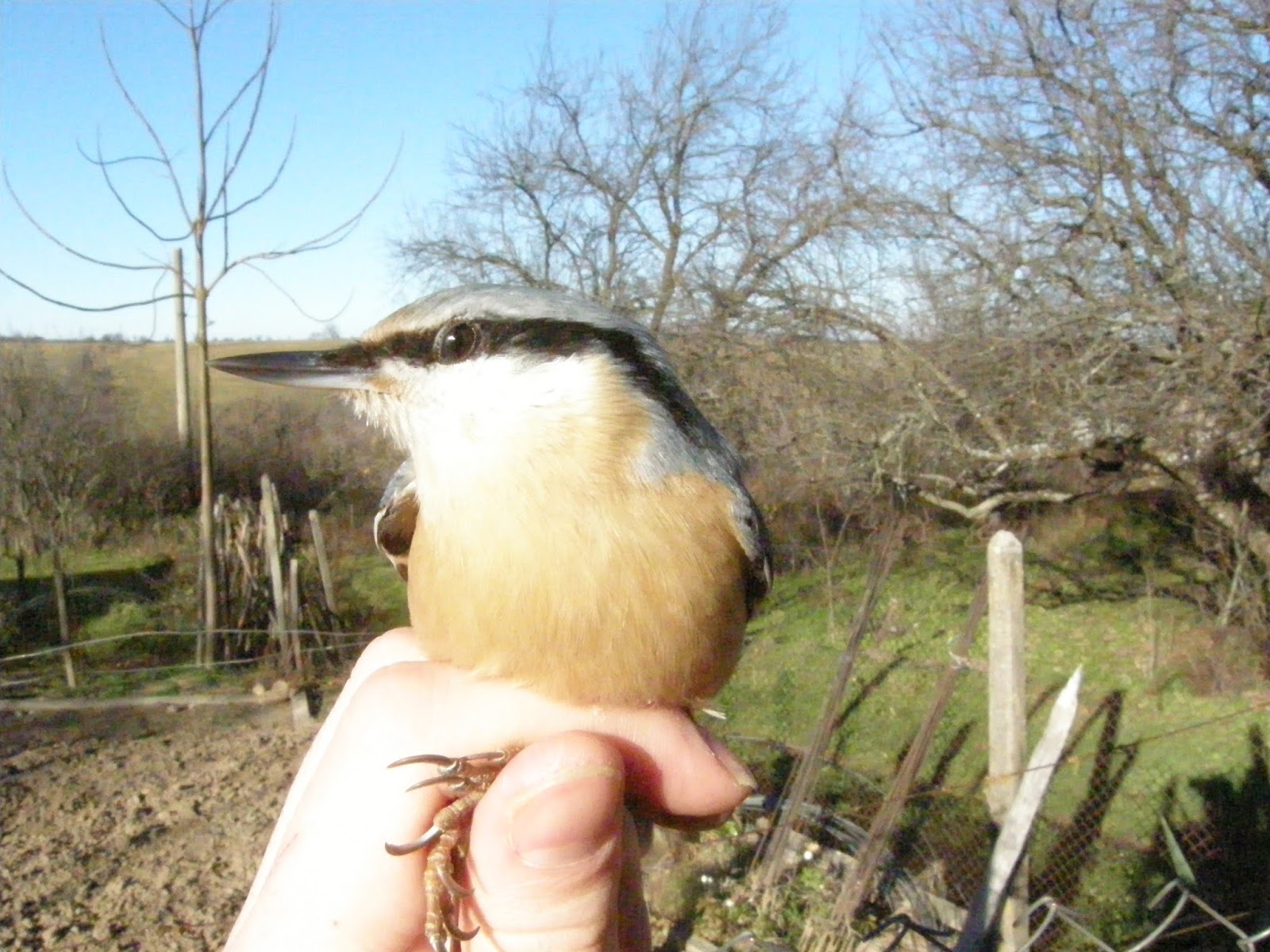
Nuthatch


 Nuthatch

Blue tit

Great tit

Nuthatch and Greenfinch

Nuthatch

 Nuthatch

Male chaffinch

Male chaffinch

Sunday, January 25, 2015

The last ringing for 2014

I know that I'm very late with this post, but I had to wait for the pictures. Around Christmas I've managed to find some time for ringing and the results were very,very good. For few days of ringing ( and few hours per day) I've ringed 48 birds from 8 species.

- Parus Major - 30
- Parus Caeruleus - 3
- Pyrrhula pyrrhula - 5
- Fringilla Coelebs -2
- Fringilla Montifringilla - 3
- Carduelis Chloris -2
- Emberiza Citrinella -1
- Parus Lugubris -2


Saturday, June 22, 2013

Interesting birds in Bulgaria - Wallcreeper (Tichodroma muraria)

It's time for another post about the interesting birds in Bulgaria.This time I will post about the Wallcreeper (Tichodroma muraria). The reason for that is because this is one very interesting bird and I think that many people don't know about it. So I've decided to share some interesting information with you.

Another reason is the fact that this bird habitats the Belogradchik Rocks which are near my hometown Belogradchik.

The Wallcreeper (Tichodroma muraria) is a small passerine bird found throughout the high mountains of Eurasia. It is the only member of the genus Tichodroma.

The Wallcreeper is a 15.5–17 centimetres (6.1–6.7 in) long bird, with a mass of 17–19 grams (0.60–0.67 oz). Its plumage is primarily blue-grey, with darker flight and tail feathers. Its most striking plumage feature, though, are its extraordinary crimson wings. Largely hidden when the wings are folded, this bright coloring covers most of the covert feathers, and the basal half of the primaries and secondaries.

A bird of the high mountains, the Wallcreeper breeds at elevations ranging between 1,000–3,000 metres (3,300–9,800 ft). It is largely resident across its range, but is known to move to lower elevations in winter, when it is occasionally found on buildings and in quarries. Birds have wintered as far afield as England and the Netherlands, where one spent two consecutive winters between 1989 and 1991 at the Vrije Universiteit in Amsterdam. The species is resident across much of the Himalayas, ranging across India, Nepal, Bhutan and parts of Tibet.


The Wallcreeper is an insectivore, feeding on terrestrial invertebrates—primarily insects and spiders—gleaned from rock faces. It sometimes also chases flying insects in short sallies from a rock wall perch. Feeding birds move across a cliff face in short flights and quick hops, often with their wings partially spread.

Pictures- wikipedia and Google images.


                          -->

Wednesday, January 9, 2013

Interesting birds in Bulgaria-Black Stork (Ciconia nigra)

I'm going to start series of posts about some of the interesting birds in Bulgaria. I will try to talk about rare birds from my hometown region. The first post will be about the Black Stork  (Ciconia nigra). This bird is very,very rare in Bulgaria ,but near Belogradchik there are several lakes where you can see Black Storks. The nearest of them is the Dubrava lake which is 5 kilometers from Belogradchik.


Slightly smaller than the White Stork, the Black Stork is a large bird, 95 to 100 cm (37–39 in) in length with a 145–155 cm (5 ft) wingspan, and weighing around 3 kilograms (6.6 lb). They can stand as tall as 102 cm (40 in). Like all storks, it has long legs, a long neck, and a long, straight, pointed beak. The plumage is all black with a purplish green sheen, except for the white lower breast, belly, axillaries and undertail coverts. The breast feathers are long and shaggy forming a ruff which is used in some courtship displays. The bare skin around its eyes is red, as are its red bill and legs. The sexes are identical in appearance, except that males are larger than females on average.
The juvenile resembles the adult in plumage pattern, but the areas corresponding to the adult black feathers are browner and less glossy. The scapulars, wing and upper tail coverts have pale tips. The legs, bill, and bare skin around the eyes are greyish green. It may be confused with the juvenile Yellow-billed Stork, but the latter has a paler wings and mantle, longer bill, and white under the wings.
It walks slowly and steadily on the ground. Like all storks, it flies with its neck outstretched. It has a rasping call, but rarely indulges in mutual bill-clattering when adults meet at the nest.


During the summer, the Black Stork is found from Eastern Asia (Siberia and China) west to Central Europe, reaching Estonia in the north, Poland, Lower Saxony and Bavaria in Germany, Czech Republic, Hungary, and Greece in the south, with an outlying population in Spain and Portugal. They are nowhere abundant in these western parts of their distribution, but more densely inhabit the eastern Transcaucasus. A population of Black Stork is also resident in Southern Africa.
Preferring more wooded areas than the better known White Stork, the Black Stork breeds in large marshy wetlands with interspersed coniferous or broadleaved woodlands, but also inhabits hills and mountains with sufficient network of creeks. It does inhabit more areas in the Caspian lowlands.


The Black Stork is a strong migrant, wintering in tropical Africa and India. A broad-winged soaring bird, the Black Stork is assisted by thermals of hot air for long distance flight, although are less dependent on them than the White Stork. Since thermals only form over land, storks, together with large raptors, must cross the Mediterranean at the narrowest points, and many Black Storks can be seen going through the Bosporus. They fly approximately 100 to 250 km a day with daily maxima up to 500 km.The storks migrate from the middle of August to the end of September. They return in the middle of March. About 10 percent of the western storks choose the passage Sicily - Cap Bon, Tunisia. The common route goes over Gibraltar. Many birds are fly around the Sahara next to the coast. Most birds are wintering in the wetlands of Nigeria or Mali. The eastern birds take the route Bosphorus-Sinai-Nile to Africa. Birds that summer in Siberia winter in northern and northeastern India. In Southern Africa, Black Storks that nest in the central montane areas perform season winter movements to warmer coastal and subtropical zones.


The Black Stork builds a stick nest high in trees or on cliffs. It nests in Central Europe in April to May, and is a winter visitor to northern India, Nepal east to Myanmar.
Black Stork parents have been known to kill one of their young, generally the smallest, in times of food shortage to reduce brood size and hence increase the chance of survival of the remaining nestlings. Stork nestlings do not attack each other, and their parents' method of feeding them (disgorging large amounts of food at once) means that stronger siblings cannot outcompete weaker ones for food directly, hence parental infanticide is an efficient way of reducing brood size. Despite this, this behaviour has not commonly been observed.