This year, I've decided to share the findings in my nestboxes with everyone by making short videos. I hope you'll enjoy the results and if you do, please like and subscribe to my YouTube channel.
Saturday, May 20, 2023

Wednesday, February 8, 2023
2022 Totals
It is once again time to share my personal ringing results for the previous year. As always, I'm quite late with this post, but I still think it's a good idea to share those stats, highlights, and personal observations with you all.
I will make a separate post about my nest monitoring results and observations of 2022, but my personal favorite was the clutch of Corn buntings(Emberiza calandra) that survived an intense hailstorm and still successfully fledged. I also managed to make a short film of a Red-backed shrike(Lanius collurio) pair feeding their young with different types of food. If you want to see this video please check it out on my Youtube channel.
For me, the highlights for 2023 were mainly the 8 Otus scops that I managed to ring, my first Caprimulgus europaeus, my first Turdus pilaris, the Ficedula species(which were also a first for me), the 11 Phylloscopus sibilatrix and the 43 Anthus trivialis.
In general, I had average ringing from the nesting season and fewer ringing days which resulted in fewer ringed birds compared to the previous year(for 2021 - total ringed: 691), but at the same time, I managed to ring 5 more species in 2022 compared to 2021(when I ringed birds out of 33 species).
Species
Sylvia atricapilla - 197
Parus major - 82
Anthus trivialis - 43
Cyanistes caeruleus - 38
Turdus merula - 22
Lanius collurio - 21
Phylloscopus trochilus - 20
Sylvia curruca - 19
Sylvia borin - 17
Sylvia communis - 13
Phylloscopus sibilatrix - 11
Parus lugubris - 10
Turdus philomelos - 10
Erithacus rubecula - 10
Muscicapa striata - 9
Otus scops - 8
Emberiza calandra - 5
Merops apiaster - 4
Emberiza citrinella - 4
Phylloscopus collybita - 4
Luscinia megarhynchos - 3
Sitta europaea - 3
Turdus pilaris - 2
Regulus ignicapilla - 2
Coccothraustes coccothraustes - 2
Aegithalos caudatus - 2
Phoenicurus phoenicurus - 2
Ficedula albicollis - 2
Streptopelia turtur - 2
Hippolais icterina - 1
Sylvia nisoria - 1
Dendrocopos major- 1
Ficedula hypoleuca - 1
Dendrocopos medius - 1
Regulus regulus - 1
Acrocephalus scirpaceus - 1
Garullus glandarius - 1
Caprimulgus europaeus - 1
Total : 577
Species: 38
Here are some of the photo highlights from 2022:
 |
| Turdus pilaris |
 |
| Sylvia nisoria |
 |
| Ficedula hypoleuca |
 |
| Otus scops |
 |
| Caprimulgus europaeus |
 |
| Emberiza calandra nest |
 |
| Streptopelia turtur hatchling |
 |
| One of the 20+ Lanius collurio nests that I found |
 |
| Merops apiaster |
 |
| Phylloscopus sibilatrix |
Sunday, November 20, 2022
Red-backed shrike (Lanius collurio) pair feeding five chicks video
This summer I've spent some time monitoring Red-backed shrike (Lanius collurio) nest because this is one of my favorite activities during the nesting season. Shrikes are extremely interesting birds and I wanted to try and get some footage of a shrike nest with hatchlings.
So I chose a nest with a suitable branch for the camera. To be honest, I was very skeptical and didn't expect any results from this experiment, but the result was much more than I expected. The camera was filming for two hours and for that time the parents brought more than 15 pieces of food - spiders, cicadas, grasshoppers, flies, and even two very long lizard tails.
I really hope that you'll find this video interesting and useful.
Does any of you have experience with nest monitoring ?
Sunday, October 30, 2022
Bird ringing camp 2022
I just got back from my one week at the Durankulak bird ringing camp and I wanted to share some observations with you.
Probably you don't know, but in the last four years, this ringing camp has become the biggest bird ringing activity in Bulgaria both in terms of total ringed birds and total different species ringed.
For two and a half months from August to the end of October, we have continuous ringing activities at the Durankulak lake which is located in the NE part of Bulgaria near the Black sea coast and the border with Romania. For more detailed information about the camp, check our Facebook page.
Every year, I'm responsible for one shift(one week) of the ringing activities at the camp. So this year I got a really late shift (from 15.10 to 22.10) which resulted in fewer birds because for most species that we target, the migration was almost over. The weather was dry, but a few of the nights were very cold(below 0). But the main problem for our ringing camp this season was a young fox that got used to checking our nets for trapped birds. It wasn't scared of humans and it managed to damage a few of our nets which forced us to either stay very close to the nets all the time or just close our forest nets in order to avoid birds being killed by the fox. We tried to catch it with a live catching trap, but without success.
Nevertheless, during my week at the camp, we've ringed two (in one day) Pallas's Leaf-warblers (Phylloscopus proregulus) and many other birds.
I can't share any data from the camp, but I'll make sure to post links to the official articles when they are ready.
If you have any questions about the camp. please let me know in the comments below.
Here are some of the highlights from my 7 days at the ringing camp:
 |
| Pallas's Leaf-warbler (Phylloscopus proregulus) |
 |
| Pallas's Leaf-warbler (Phylloscopus proregulus) |
 |
| Pallas's Leaf-warbler (Phylloscopus proregulus) |
 |
| Dunnock (Prunella modularis) |
 |
| Chaffinch (Fringilla coelebs) |
 |
| Common kingfisher (Alcedo atthis) |
 |
| the sunset over the lake |
 |
| Bearded reedling (Panurus biarmicus) |
 |
| Male Sparrowhawk (Accipiter nisus) |
 |
| Brambling (Fringilla montifringilla) |
 |
| Firecrest (Regulus ignicapilla) |
 |
| Moustached warbler (Acrocephalus melanopogon) |
 |
| Reed bunting (Emberiza schoeniclus) |
 |
| Black redstart (Phoenicurus ochruros) |
 |
| Bluethroat (Luscinia svecica) |
 |
| Red-breasted flycatcher (Ficedula parva) |
 |
| Greenfinch (Chloris chloris) |
 |
| Goldcrest (Regulus regulus) |
Friday, April 29, 2022
Spring ringing 23-24.04.2022
In the last few years, I'm trying to limit my spring ringing attempts since spring migration at my usual site is very scarce.
This year, during our Easter holidays we had a very visible wave of flycatchers and I couldn't resist putting up the nest and trying to ring some of them. The highlights for sure are the two Collared and one Pied flycatchers, which are my first ringed birds from those species. Nice addition was my third Barred warbler.
Total: 19
Collared flycatcher (Ficedula albicollis) - 2
Pied flycatcher (Ficedula hypoleuca) - 1
Great spotted woodpecker (Dendrocopus major) - 1
Whitetroat (Sylvia communis) - 5
Blackcap(Sylvia atricapilla) - 2
Great tit (Parus major) - 2
Barred warbler (Sylvia nisoria) - 1
Blackbird (Turdus merula) - 3
Robin (Erithacus rubecula) - 1
Nightingale (Luscinia megarhynchos) - 1
 |
| Barred warbler (Sylvia nisoria) |
 |
| Barred warbler (Sylvia nisoria) |
 |
| Collared flycatcher (Ficedula albicollis) |
 |
| Collared flycatcher (Ficedula albicollis) |
 |
| (Dendrocopus major) |
 |
| Robin (Erithacus rubecula) |
 |
| Whitetroat (Sylvia communis) |
 |
| Nightingale (Luscinia megarhynchos) |
 |
| (Ficedula hypoleuca) |
Sunday, April 10, 2022
First nest of the season
The weather here in Bulgaria has improved in the first days of April and the breeding season began with full speed.
While some of our migrating birds are just arriving, others have already started incubating.
I usually try to monitor and ring nests near my hometown, but yesterday I couldn't resist looking for some nests in one of the parks here in Sofia.
During my one-hour walk, I've found five active nests (3 Turdus merula and 2 Turdus philomelos). Most of them are very high in the trees since the park lacks any low-growing bushes.
Hopefully next week I'll be able to spend much more time searching and recording nests, but in general, I just hope for a successful season and many fledged young birds.
 |
| Turdus philomelos nest |
 |
| Female Turdus merula |
Thursday, February 17, 2022
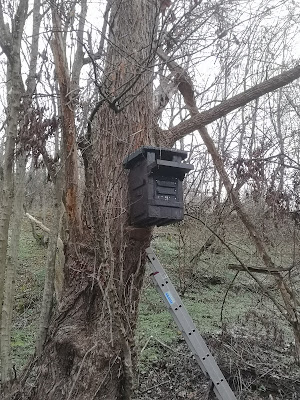
First Tawny owl nestbox
I finally decided to try and make a Tawny owl nestbox. In the last month, I've managed to assemble 20 nestboxes for Tits/Flycatchers, but my brother convinced me that I should try to construct a bigger next box for Tawny owls or Barn owls.
I checked some articles and videos describing how to make a proper Tawny owl nest box, but I mainly follow the RSPB scheme and tips. It took me more than one week to finish it because I can only spare a few hours after work.
The entrance is 20x20cm, the depth of the next box is 60cm and in general, the next box is well insolated so I assume I've covered the main requirements. The main problem that I can think of is that the middle of February probably is quite late in the season for me to expect a Tawny owl pair using it for this season.
In any case, I intend on making more boxes for next year, because of the lack of natural tree holes and suitable nest sites in the area.
Of course, I'll be very happy if someone can give me some advice on how to make the next one better.
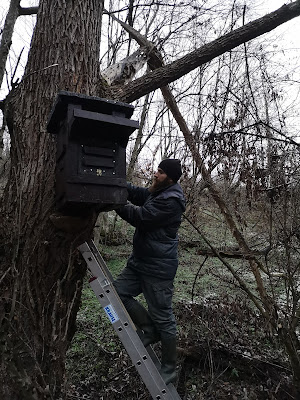 |
| Attaching the nest box |
Subscribe to:
Posts (Atom)

-
 In the past year, I was unable to find time for enough ringing sessions. Anyways, I will catch up with few post about my ringing activities ...
 -
 I live in Sofia more than a year and I can tell you the main bird species here. The first bird you will see here is the Magpie. There are v...
 -
 I'm going to start series of posts about some of the interesting birds in Bulgaria. I will try to talk about rare birds from my hometown...